
Authentication, Enumeration & Predictable Tokens (TryHackMe Lab)
Overview
This lab explored common weaknesses in authentication mechanisms, focusing on how small implementation details — particularly error messages and token generation — can introduce real security risks.
Rather than relying on complex exploitation, the exercises showed how attackers can gather useful information simply by observing how an application behaves.
User Enumeration via Error Messages
One of the most straightforward issues demonstrated was user enumeration through login responses.
When attempting to log in:
- Invalid email → “Email does not exist”
- Valid email, incorrect password → “Invalid password”
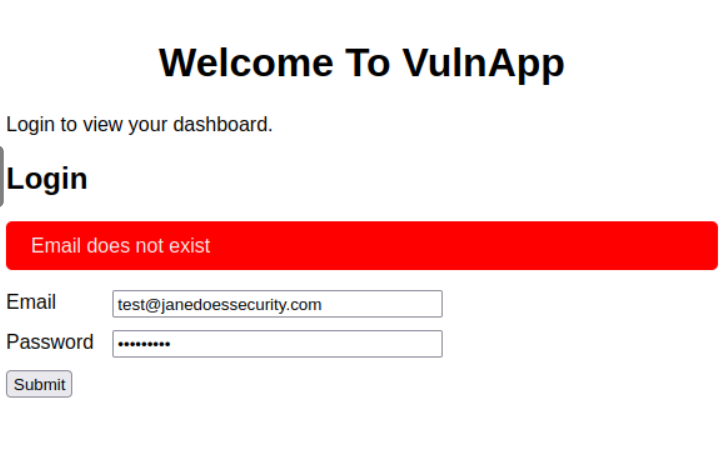
This difference allows an attacker to confirm whether an email address is registered.
From a security perspective, this is a subtle but impactful flaw:
- It reduces the effort required for brute-force attacks
- It enables targeted attacks against known valid accounts
Automating Enumeration
To scale this process, enumeration can be automated.
By sending multiple login attempts and analysing the responses, it becomes possible to quickly identify valid users.
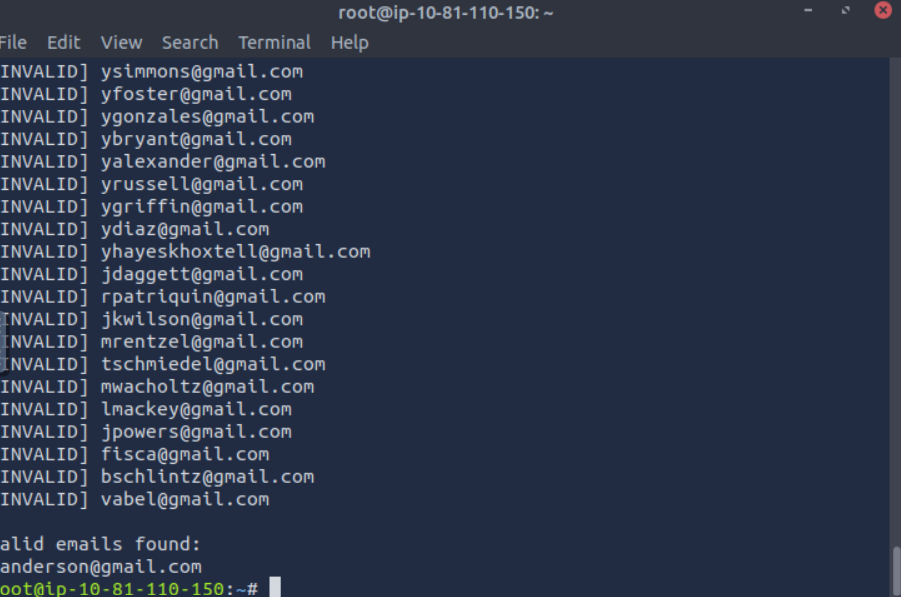
This highlights an important point:
Small information leaks become far more serious when automated.
Enumeration is rarely the end goal — it is typically used to reduce the search space before attempting further attacks, such as password brute forcing.
Predictable Tokens and Burp Intruder
The lab then moved on to password reset functionality, specifically focusing on predictable tokens.
A request was captured in Burp Suite and the token parameter was identified as a target for brute forcing:
GET /labs/predictable_tokens/reset_password.php?token=§123§ HTTP/1.1
Host: enum.thm
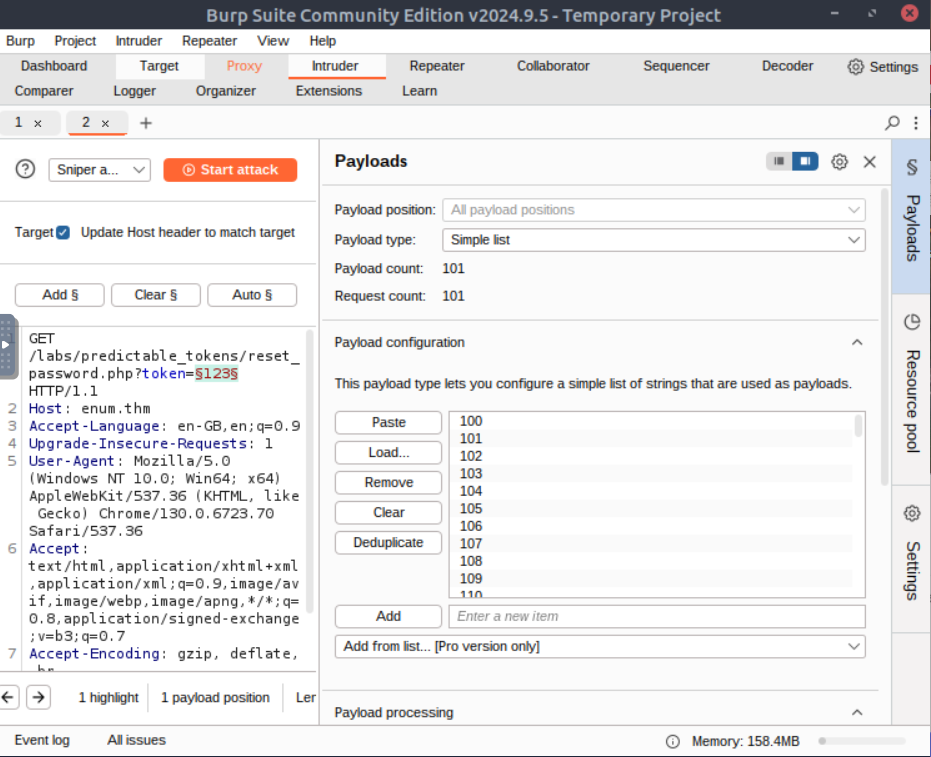
A list of potential tokens was generated using crunch:
crunch 3 3 -o otp.txt -t %%% -s 100 -e 200
This created a list of numeric tokens within a defined range, which were then used as payloads in Burp Intruder.
Identifying the Valid Token
When the attack was executed, most responses appeared identical. However, one request produced a different response, indicating a valid token.
This demonstrates a common weakness in poorly implemented reset mechanisms:
- Tokens are predictable
- There is no rate limiting
- There is no additional validation step
Even a small, constrained token space becomes exploitable under these conditions.
Password Reset Weaknesses
The lab highlighted several risks associated with password reset functionality:
- Predictable tokens → can be guessed or brute forced
- Token expiration issues → increase the attack window
- Weak identity validation → makes account takeover easier
- Information disclosure → supports enumeration
- Insecure transport (HTTP) → risks interception of reset links
Key Takeaways
- Authentication vulnerabilities are often logic-based rather than technical complexity
- Error messages should be consistent and non-descriptive
- Enumeration is typically a precursor to more targeted attacks
- Token generation must be random and unpredictable
- Small weaknesses become significant when combined and automated
Reflection
What stood out in this lab is how realistic these issues are.
None of the techniques required advanced exploitation — just:
- Observing application behaviour
- Identifying patterns
- Applying simple automation
From a defensive perspective, this reinforces the importance of:
- Reviewing how systems respond to invalid input
- Designing authentication flows carefully
- Balancing usability with security
Final Thoughts
This lab is a good reminder that:
Security weaknesses often come from design decisions, not just technical mistakes.
Even small differences in behaviour can provide attackers with enough information to move forward.